
A hobbyist project shows an Arduino-powered car building a map of its environment while tracking its own position.
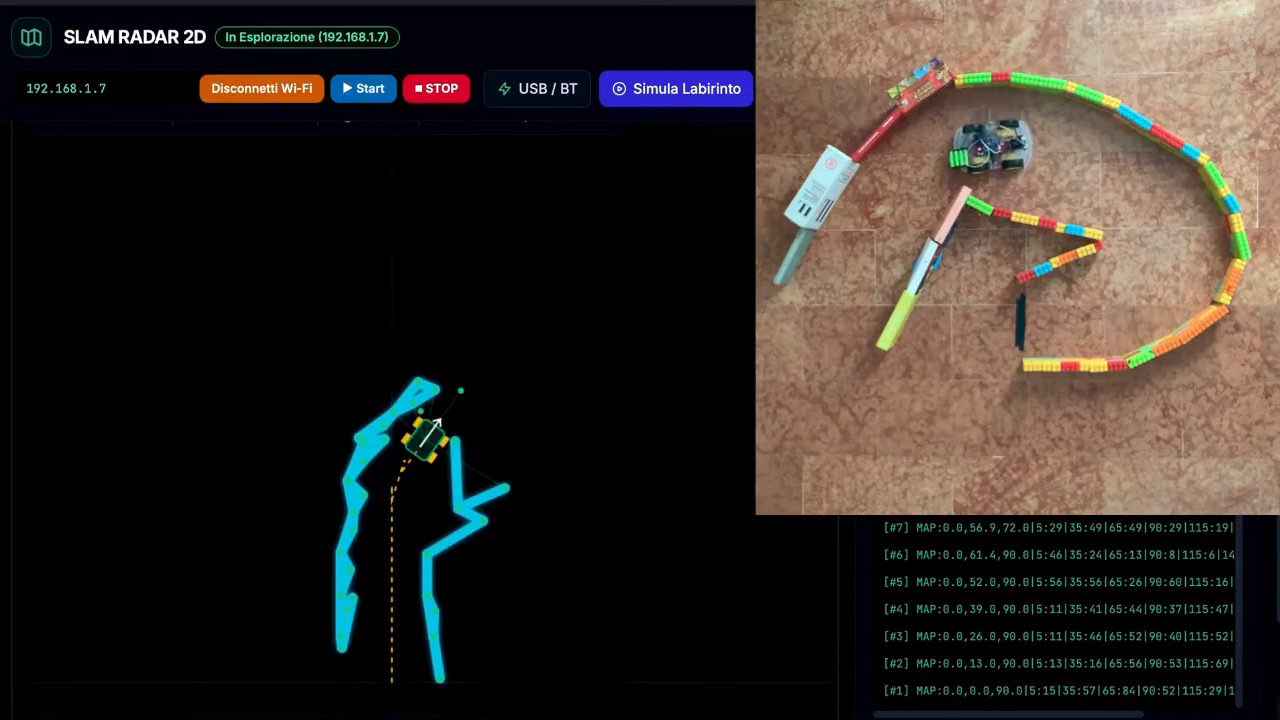
Many robots labeled as autonomous are really just remote-controlled platforms. A project by Luca Fagioli takes a more independent approach, using Simultaneous Localization and Mapping (SLAM) so that a small robot can explore a space and work out where it is within it.
The explorer is built on a small plastic chassis with a gear motor driving each wheel. An Arduino Uno R4 Wi-Fi handles control, working alongside a Sensor Shield 5.0 and an L298N motor driver board. An HC-SR04 ultrasonic sensor, mounted on an SG-90 servo, can pan to measure distances to nearby walls. As the robot measures these ranges, it builds a map and localizes itself within that map at the same time. Infrared sensors on the underside detect tape marks on the floor, which serve as checkpoints.
SLAM is often implemented with expensive laser rangefinders or time-of-flight sensors, so this build is notable for showing that simpler hardware can handle the task. The same general technique has also been demonstrated with multiple drones sharing their observations to map an area together.
For hobbyists, the project illustrates how mapping and navigation can be brought down to low-cost microcontroller hardware, making it a useful reference for anyone interested in robot wayfinding.
Source: Hackaday