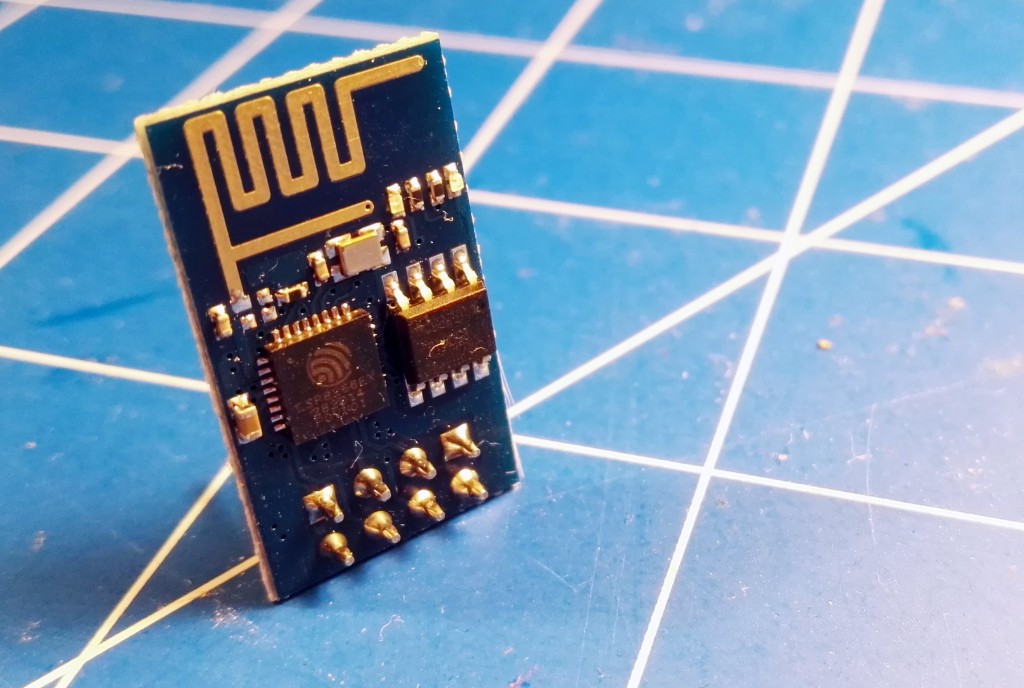
ESP32-S31: Specs, Architecture and ESP32-S3/C3 Comparison
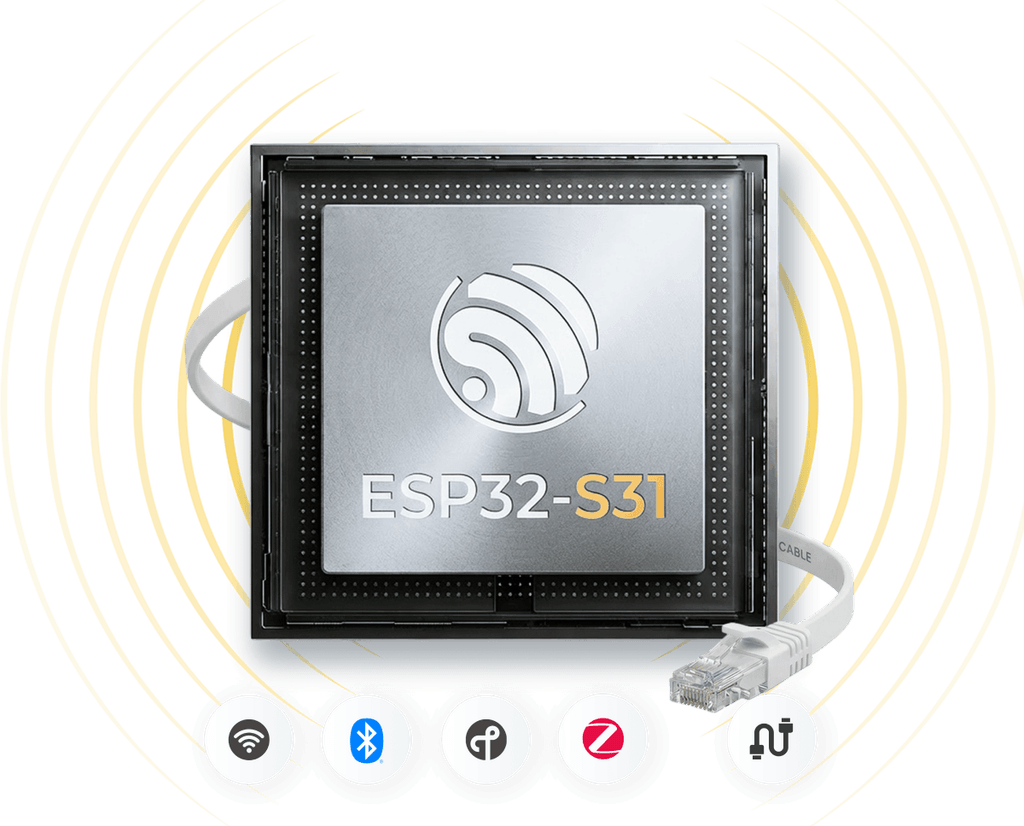
The ESP32-S31 is Espressif’s new dual-core RISC-V chip with Wi-Fi 6, Bluetooth 5.4, Thread, Zigbee and Gigabit Ethernet all on one die. It’s another chip you didn’t ask for, but will probably buy anyway. Below: what the ESP32-S31 is, its architecture, what it’s good and bad at, and whether it replaces the ESP32-C3 and ESP32-S3 (spoiler: one of them should be worried).
What is ESP32, anyway?
If you have ever soldered anything that blinks and talks to Wi-Fi, you have met an ESP32. You may not have been formally introduced, but it was there. Probably on a blue board from AliExpress, probably with a USB port that wobbles.
The story starts with the ESP8266, a tiny Wi-Fi chip from the Shanghai company Espressif. It was meant to be a boring Wi-Fi modem you talk to with AT commands. Then the hobbyist crowd noticed it had a CPU, memory and GPIOs, and decided that “modem” was just a suggestion. A whole generation of smart sockets was born in a garage.
In 2016 Espressif released the original ESP32: two Xtensa cores, Wi-Fi, Bluetooth, and a price that made Arduino boards look like luxury goods. It became the default answer to “what microcontroller should I use for my IoT thing?” mostly because nobody wanted to think about it any harder.
Since then, “ESP32” stopped being a chip and became a brand, a family, and a naming puzzle. There are S-series chips (the beefy ones), C-series (the cheap RISC-V ones), H-series (low power, Thread and Zigbee), and a P-series (the one without any radio, because why not). Espressif’s product menu now lists over a dozen ESP32 variants. Picking one is a bit like ordering coffee in a hipster cafe: you know you want caffeine, but the menu has opinions.
So what is the ESP32-S31?
The ESP32-S31 is Espressif’s attempt to put every radio it owns, plus Gigabit Ethernet, into one chip and call it a day. It was announced in March 2026, entered mass production on July 27, 2026, and the bare chip launched at $4.51 on AliExpress. Plus about $34 shipping if you buy one, which is a lovely way to learn about economies of scale.
Here is what you get, according to Espressif and friends:
Area
ESP32-S31
CPU
2x 32-bit RISC-V up to 320 MHz; one core has a 128-bit data path with SIMD
Low-power core
40 MHz RISC-V coprocessor with 32 KB of its own SRAM
Memory
512 KB SRAM, external flash and PSRAM up to 250 MHz
Wi-Fi
Wi-Fi 6 (802.11ax), 2.4 GHz only
Bluetooth
5.4 LE with LE Audio, Mesh 1.1, plus Classic BR/EDR
802.15.4
Thread 1.4, Zigbee 3.0, Matter over Wi-Fi or Thread
Wired
Gigabit Ethernet MAC (bring your own PHY), USB 2.0 OTG High Speed
Up to 60 GPIOs, 14 touch channels, 2x 12-bit ADC, 4 DACs, 4x MCPWM
Security
Secure boot, flash/PSRAM encryption, PUF, TEE, side-channel and glitch protection
The headline: this is the first ESP32 that does Wi-Fi 6, Bluetooth Classic (yes, the old audio stuff is back), Thread/Zigbee and wired gigabit networking all at once. It is basically an ESP32-S3, an ESP32-H2 and an Ethernet adapter that moved in together and now share one rent.
The naming deserves its own paragraph. “S31” suggests it follows the S3. Architecturally, it doesn’t: the S3 is Xtensa, the S31 is RISC-V. So it is the S3’s successor in the same way a Tesla is the successor of a horse. Same job, different everything under the hood. Hackaday predicted the name would upset and confuse many. They were right.
ESP32-S31 architecture and block diagram
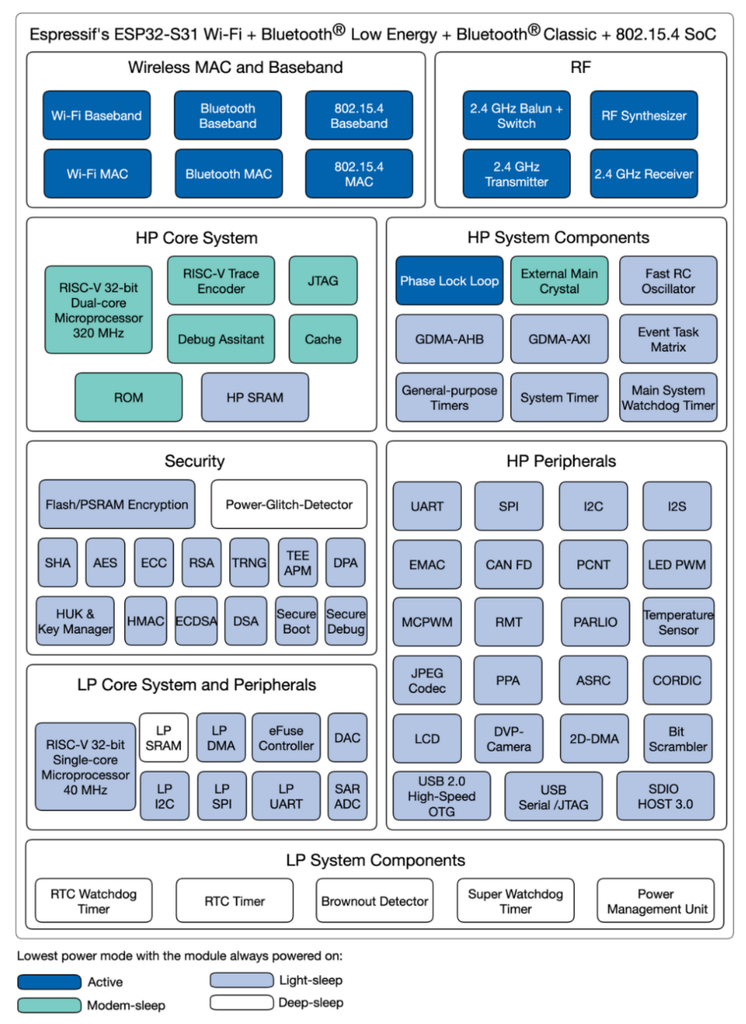
Under the hood the S31 is a high-performance CPU island, a low-power island that stays awake while the big cores nap, a radio block that speaks four languages, and a pile of peripherals hanging off a shared bus. Boxes and arrows make everything look official, so here it is as PlantUML. Paste it into any PlantUML renderer:
Note the bit everybody misses: only one of the two big cores has the 128-bit SIMD unit. So “dual-core AI chip” really means “one core does the math, the other one handles Wi-Fi and pretends to be busy”. Also, the Ethernet is a MAC only. The PHY is your problem, and your BOM’s. The RGMII label is an assumption about the PHY interface; check the datasheet before you route anything.
What is the ESP32-S31 designed for?
Espressif’s official pitch is “next-generation AIoT”. Translated from marketing to English: smart home hubs, smart speakers, edge AI gadgets and industrial automation, in their own words. Now, “AIoT” means the chip can run small neural networks on its SIMD core. It does not mean your light switch will write poetry. Let’s look at where it actually makes sense.
Smart home hubs and Matter bridges. This is the real sweet spot. Until now, a Thread Border Router on Espressif silicon meant two chips: an S3 for Wi-Fi and an H2 for Thread. The S31 does both on one die, plus Zigbee, plus Ethernet. One chip, one firmware, one fewer UART link to debug at 2 AM.
Smart speakers and audio gadgets. Bluetooth Classic, LE Audio, dual I2S with hardware audio sync and a sample-rate converter. Somebody at Espressif clearly got tired of hearing “but the C6 can’t do A2DP”.
Small displays and control panels. Parallel RGB LCD, a 2D accelerator, JPEG codec and 14 touch channels. Think thermostats, washing machine panels, the kitchen dashboard that shows the weather you could have checked on your phone.
Wired industrial gear. Gigabit Ethernet, 60 GPIOs, four motor-control PWM units and a proper security stack (secure boot, encryption, TEE, glitch protection). Industrial people love cables, and they love not getting hacked even more.
Wireless coprocessor. You can also bolt it to a bigger host and use it as a radio via ESP-Hosted or ESP-AT. Expensive modem, but a very well-connected one.
What the ESP32-S31 is not good for
Every chip that does everything is, by definition, bad at something. Here is where the S31 is the wrong tool, no matter how shiny the press release.
Coin-cell sensors. A dual-core 320 MHz chip with four radios is not your door sensor running on a CR2032 for five years. Yes, there is a low-power core. No, it will not turn a race car into a bicycle. For that, look at the ESP32-H series or any of the Nordic chips your battery-obsessed friends keep recommending.
Serious video. No MIPI CSI, no MIPI DSI, no H.264 encoder. The ESP32-P4 keeps those. The S31 can grab frames from a DVP camera and squeeze out JPEGs, which is fine for a doorbell snapshot and sad for anything that calls itself a “stream”. Commenters on CNX also noted the octal PSRAM may feel tight for high-resolution displays.
5 GHz Wi-Fi. Wi-Fi 6, but 2.4 GHz only. If your project lives in a block of flats where 2.4 GHz is a war zone of 40 neighbouring routers, the ESP32-C5 is the dual-band one.
Actually saturating Gigabit Ethernet. It has a Gigabit MAC. It also has a 320 MHz CPU and 512 KB of RAM. Do the math and lower your expectations. It is great for low latency and reliability. It is not your new NAS.
The $1 blinky. If your project is “relay + Wi-Fi + app”, the S31 is overkill with a premium price tag and a bunch of silicon you will never touch. Also: brand new chips mean fresh ESP-IDF support, thin Arduino and community coverage, and Stack Overflow answers that do not exist yet. Early adopter tax is real.
ESP32-S31 vs ESP32-S3, C3 and C6: will it replace them?
Short answer: no. Long answer: noooo, but it will eat a couple of them from the inside.
Chip
CPU
Wi-Fi
Other radios
GPIO
Role in life
ESP32-S31
2x RISC-V 320 MHz + LP core
Wi-Fi 6, 2.4 GHz
BT 5.4 LE + Classic, Thread, Zigbee, GbE MAC
up to 60
Hub, speaker, panel, gateway
ESP32-S3
2x Xtensa LX7 240 MHz
Wi-Fi 4
BLE 5
45
Displays, AI-ish stuff, legacy favourite
ESP32-C6
1x RISC-V 160 MHz + LP core
Wi-Fi 6, 2.4 GHz
BLE 5, Thread, Zigbee
~30
Cheap Matter devices
ESP32-C3
1x RISC-V 160 MHz
Wi-Fi 4
BLE 5
22
The $1 workhorse
S31 numbers are from Espressif; S3, C6 and C3 figures are from memory of their datasheets, so treat them as approximate.
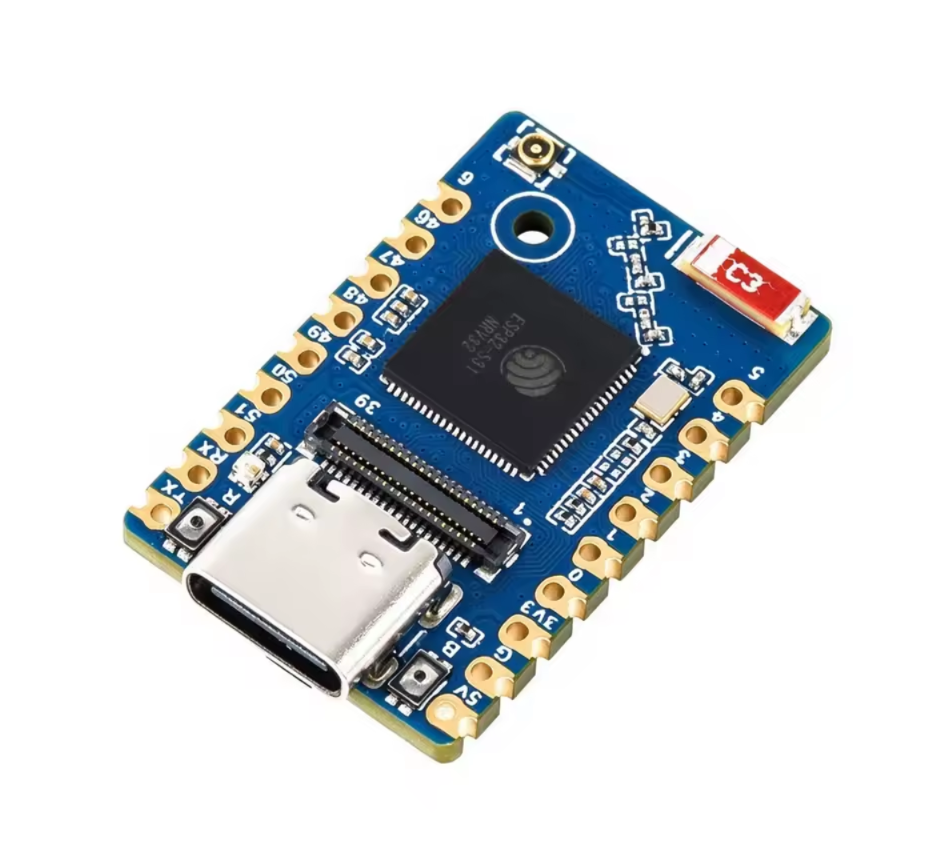
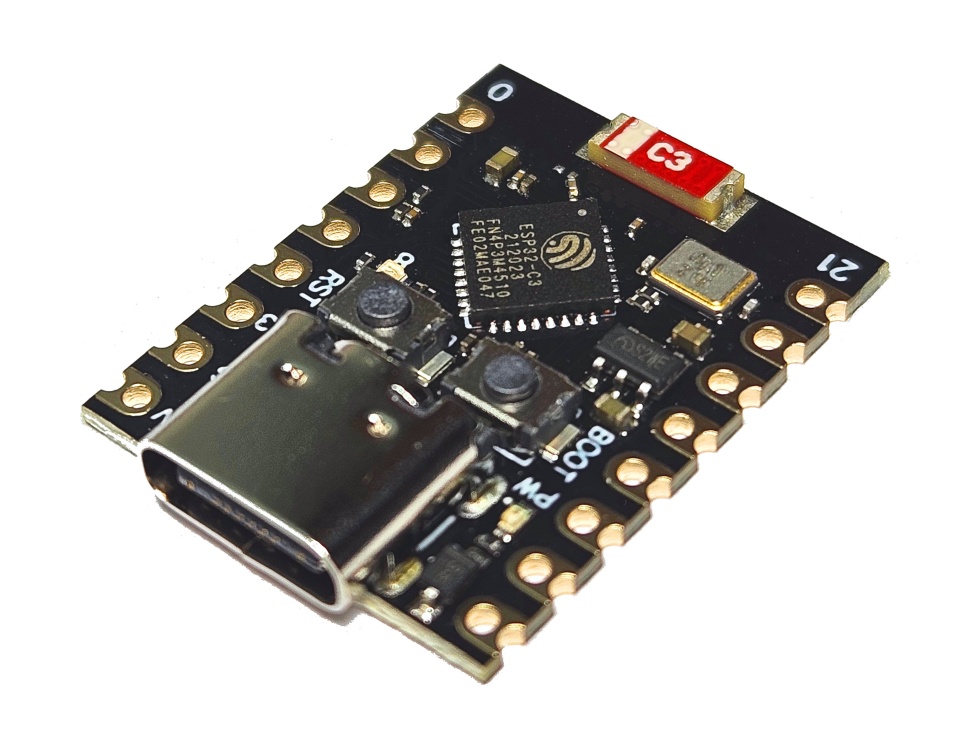
The C3 is safe. The C3 does not win on features. It wins on being cheap, tiny, boring and supported by literally everything. Smart plugs, relays, sensors on USB power. The S31 costs several times more and needs more board space. Product managers counting cents per unit will not switch, and neither will the hobbyist buying ten C3 SuperMinis for the price of a kebab.
The S3 should be nervous. The S3 is the chip the S31 most directly threatens: same “powerful ESP with displays” niche, but the S31 adds Wi-Fi 6, Thread, Zigbee, Ethernet and High Speed USB. New designs that would have picked an S3 will increasingly pick the S31. Existing S3 products will happily keep shipping for years, because nobody rewrites working firmware for fun. Except you, probably.
The “S3 + H2” combo is dead. Two-chip border router and gateway designs were always a bit of a hack. The S31 replaces both with one part. RIP to that extra UART.
The C6 lives on. It covers the cheap Matter-over-Thread end device. The S31 is a hub; the C6 is the thing the hub talks to.
The P4 shrugs. It keeps the video crown thanks to MIPI and H.264, and has no radio of its own anyway.
So the S31 is not a replacement for the ESP32 family. It is a new top shelf. Espressif did what it always does: add another variant, make the selection table one row longer, and let us argue about it on forums. And honestly? It’s a pretty good chip. Don’t tell anyone I said that.